Why the technology behind your comms matters, and what DECT does differently
What is DECT?
DECT (Digital Enhanced Cordless Telecommunications) is primarily used for voice telephony and offers an outdoor range of over 1500 feet. Because it is optimized for real-time voice communication, it features extremely low latency, a secure wireless connection and low power consumption, making it ideal for battery-powered communication devices.
Why This Matters to You
DECT ensures crystal-clear, real-time communication between your crew, dispatch, command and other team members. By utilizing this technology team comms are interference free, reliable, encrypted & secure, long-ranging, and last all day on a single charge.
Unlike other technologies, DECT does not rely on other headsets to maintain the connection between firefighters. This means that if a headset is damaged or out of range, other crew members do not lose comms or miss a command.
DECT headsets can incorporate internal antennas, reducing the risk of damaged equipment or entanglement. Instead, Firecom incorporates a central base station to ensure this high level of performance and connectivity.
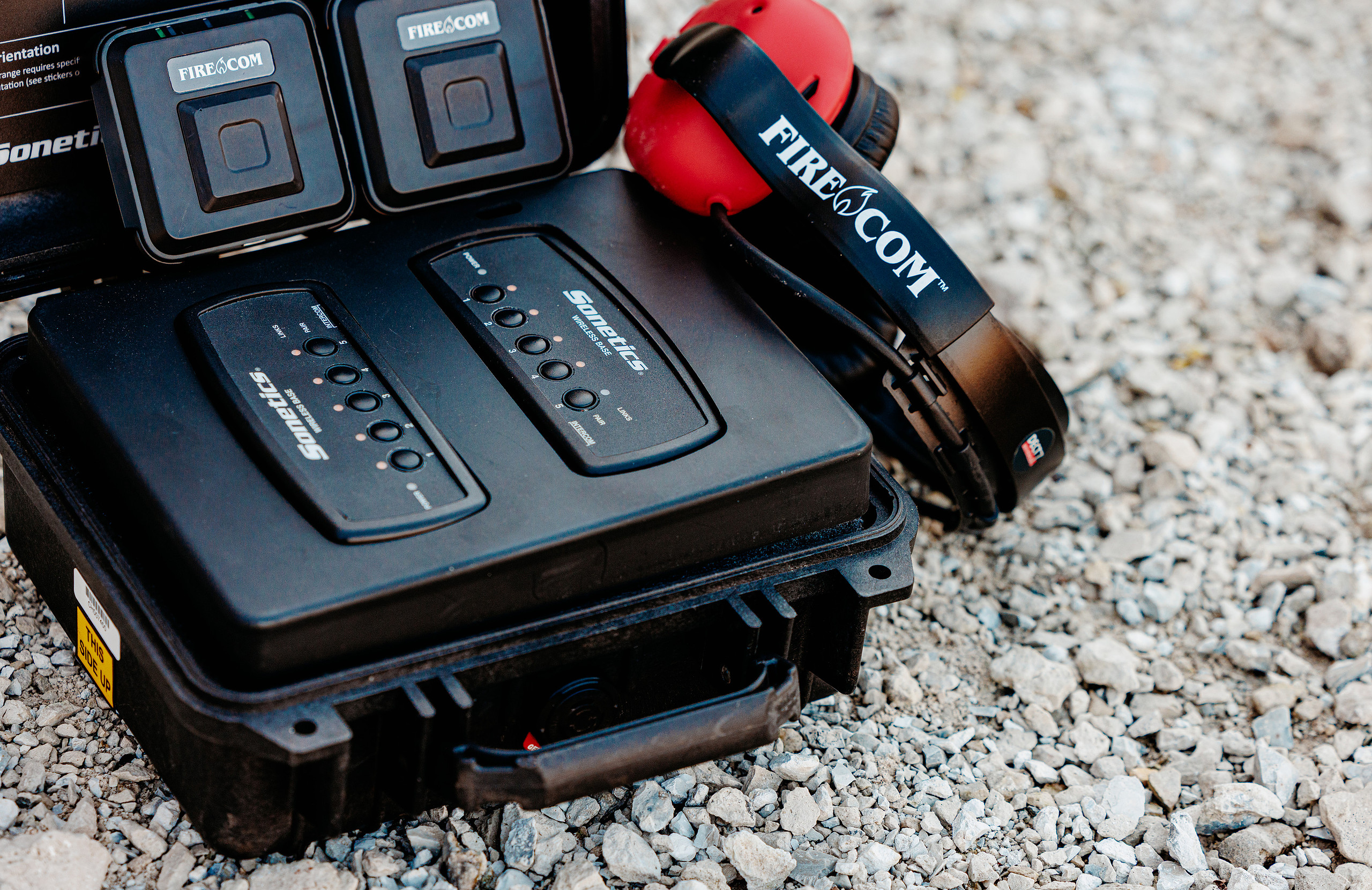
The base station provides a consistent, reliable and exceptional audio experience, but also allows Firecom to be packaged into a portable ComHub system that can be taken downrange. This offers a new level of flexibility to use hands-free, 2-way communications in ways other systems can’t.
Firecom’s communication hub (ComHub) transforms how firefighters connect, offering versatile new communication methods across the entire Firecom ecosystem.
- Broad Operational Support: Enhances communication during driver/tiller training, tactical evolutions, roof operations, and saw work.
- Specialized Response Ready: Keeps drone units, USAR, wildland crews, high-angle rescue, and boat teams seamlessly connected.
- Fleet-Wide Integration: Easily deployable across command vehicles, UTVs, and reserve apparatus.
- Bluetooth Capability: Connects lightweight, two-way Bluetooth devices directly into your existing communication network.
Firecom’s DECT-based system provides reliable, secure, ultra-clear communication to make firefighters’ and first responders’ work easier and safer: onboard apparatus or downrange.
Differences between headset technologies: (DECT vs. ISM Frequency)
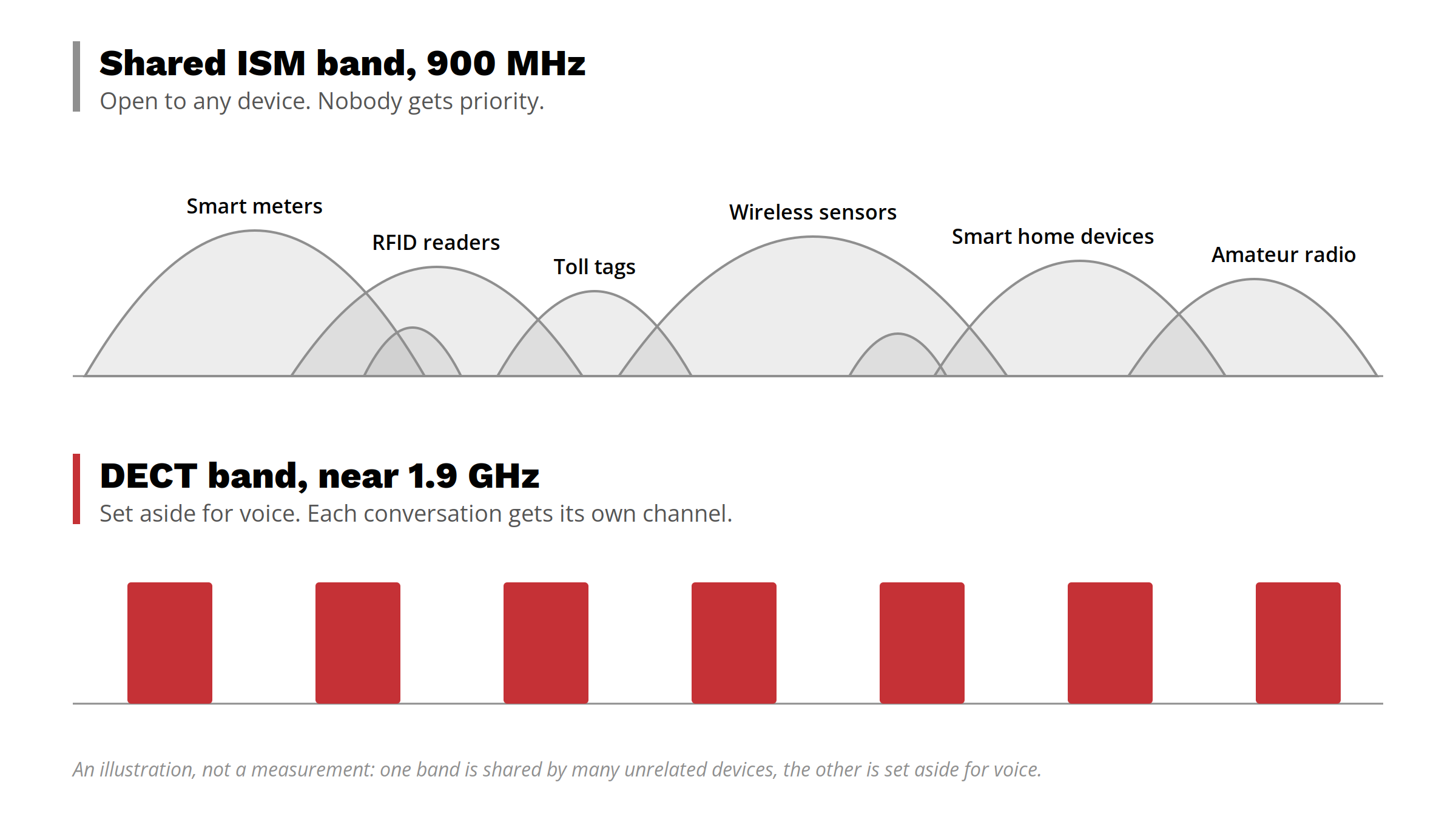
Wi-Fi, Bluetooth, baby monitors, microwaves, and countless other devices all compete for the same spectrum. This requires collision avoidance protocols (CSMA/CA, frequency hopping, etc.) to manage congestion. In general, communications equipment operating in ISM bands must tolerate any interference generated by ISM applications, and users have no regulatory protection from ISM device operation.
ISM (Industrial, Scientific, and Medical) refers to a collection of unlicensed bands open to anyone, and full of devices you’d never think about. ISM bands are a shared “wild west.” Wi-Fi, Bluetooth, Utility smart meters, RFID and toll-tag readers, smart home devices and amateur radio, but also 433 MHz, 868 MHz, and 915 MHz. Under FCC rules, devices there must accept whatever interference they get. In short, the ISM band is like a massive, unregulated public highway. Everyone is allowed to drive on it for free, but you must deal with the traffic jams, the noise, and the chaotic mix of vehicles.
DECT operates on a dedicated, protected spectrum (called DECT 7.0). This band is reserved exclusively for DECT devices by regulatory bodies and is like a special toll road reserved for your team.
Benefits of DECT Headset Technology
- Latency — No lag: When you speak, you are heard instantaneously
- Security – Encrypted for secure conversations without interference
- Connectivity – The DECT 7.0 Base station provides a stable connection, eliminates headset antennas and provides options for portability
- Flexibility – Used headsets onboard apparatus, take them downrange, use as a training tool for easy instructing, incorporate lightweight, 2-way Bluetooth devices into the system, use as a tool in training for easy instruction and in a variety of other functions Fire Rescue and EMS agencies perform.
- Large Teams – DECT allows for large groups. In the case of Firecom – Up to 100 users in broadcast mode for large group training and other scenarios expanded capabilities are needed.
Why Firecom uses DECT as its platform
Because Firecom’s DECT 7.0 platform uses a dedicated, protected wireless, no other device types are permitted in this band. This exclusivity guarantees minimal interference and consistently low latency (No delay between speaking and hearing.)
The DECT base station creates stable connectivity between headsets, and the flexibility to create portable systems that are not restricted to onboard apparatus communications.
Reliability is also paramount. Because its technical specifications are so strictly defined, DECT devices are highly consistent and reliable across the board.
DECT is also a highly encrypted and secure signal; imperative (or necessary) for mission critical communications within the Fire Service, US Military, Major Airlines and other markets we serve.
Factors to consider with ISM vs. DECT
While self-forming, peer-to-peer networks like ISM offer incredible flexibility straight out of the box, relying on the headsets themselves to maintain the network infrastructure introduces several physical and technical limitations:
- Vulnerability to Ground-Level Obstructions: In a headset-to-headset network, the antennas are at head-level and operate on lower power. If a user walks behind a large metal structure, descends into a concrete trench, or enters a thick-walled building, the environment absorbs the RF signal and the network may drop much faster. When a network relies on an elevated, high-power base station (like an antenna mounted on the roof of a fire engine), the signal easily clears most ground-level obstacles.
- The “Weak Link” Split: Because the headsets act as nodes in a dynamic web, they rely on each other to bridge distances. If a crew stretches out into a long line, the network often depends on the middle users to relay the signal. If the person in the center of the line walks away, steps behind a truck, or their battery dies, the single network instantly fractures into two isolated groups—severing communication between the front and the back.
- Hard Caps on Crew Size: A peer-to-peer network must dedicate significant bandwidth to coordinate the dynamic connections and process continuous, full-duplex (open mic) audio from every single node simultaneously. Because of this high local bandwidth cost, these localized systems usually cap out at a strict limit—typically 7 to 8 users per channel. They cannot scale to accommodate a 20-person crew on a single local intercom.
- Increased Battery Drain: In a traditional hub-and-spoke setup, a headset only needs enough power to talk to one stationary base station. In a self-forming network, every headset is constantly working overtime to scan the environment, broadcast its presence, ping peers, and maintain the group connection. This continuous processing and routing draws more power.
- Lack of Centralized Override: When multiple headsets are acting as equals on an open, full-duplex channel, there is no centralized “traffic cop.” If all users are breathing heavily or operating loud machinery that triggers their microphone thresholds at the same time, the channel becomes cluttered with background noise. Unlike a base-controlled system, these ad-hoc local networks usually lack a hierarchical override feature that allows a supervisor to instantly mute lower-priority mics during a critical moment.
We know that every department runs differently. If you want to talk through whether Firecom is the right fit for yours, feel free to reach out: 800-527-0555.