Four reasons your crew’s comms belong on DECT
Before you choose a headset system, ask one question: what band?
A lot of wireless headset systems run on 900 MHz. It’s a familiar band, but it’s also a shared one. Here’s why the band behind your comms matters, and what DECT does differently.
1. No latency – It doesn’t share its band with everything else
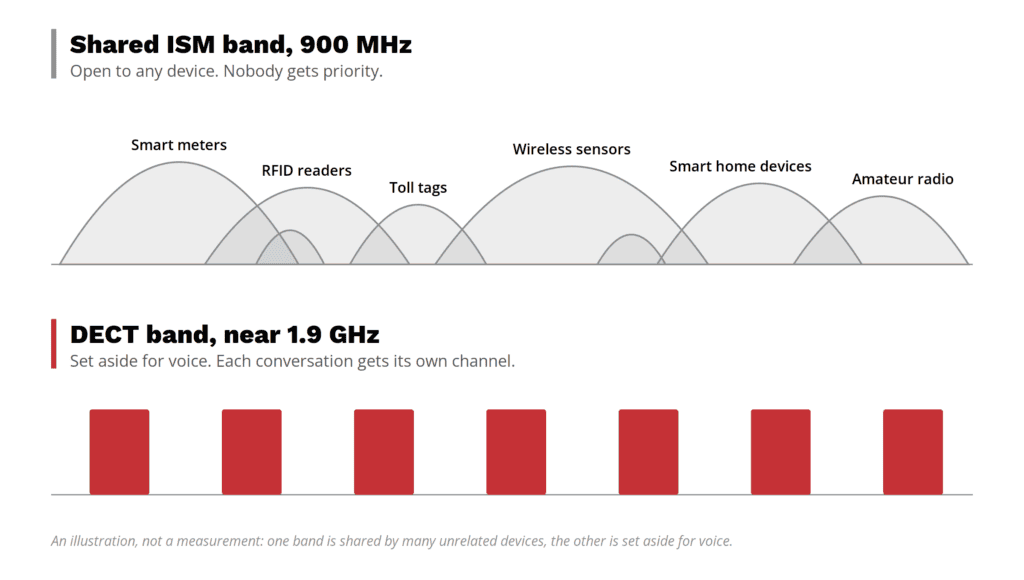
900 MHz is part of the ISM band: unlicensed, open to anyone, and full of devices you’d never think about. Utility smart meters, RFID and toll-tag readers, wireless sensors, smart home devices, and amateur radio all use it. Under FCC rules, devices there have to accept whatever interference they get. DECT runs in its own band near 1.9 GHz, set aside for voice, so your headsets aren’t sharing the air with the meter on every building.
2. It was built for conversation
A shared band is designed to carry anything, including data, telemetry, and voice. DECT was designed from the start for real-time voice, with very low latency, so the driver and pump operator can talk back and forth naturally.
DECT vs. ISM
3. It works the same way every time
ISM isn’t a standard, just an open band where unrelated technologies coexist, each managing interference its own way. DECT is one tightly defined voice standard, and headsets pair with their own base station by design. Power it on, and it behaves the way it did yesterday.
4. The 900 MHz band is only getting busier
Smart meters, connected sensors, and smart home networks keep adding traffic to 900 MHz. So do other wireless systems when mutual aid companies arrive. A system on a dedicated band doesn’t have to keep up with the neighborhood, so the clarity your crew has today is the clarity they’ll have years from now.
Bottom line:
Think of 900 MHz as a public road: free and open to every kind of vehicle. DECT is a dedicated lane built for one kind of traffic, which is voice.
Hear the difference on your own apparatus
Firecom wireless systems run on DECT and are built for the pump panel, the apparatus, staging, and training. If you’re weighing options, we’re happy to walk through how it works with your setup.